How to spot a patched roof repair in satellite imagery
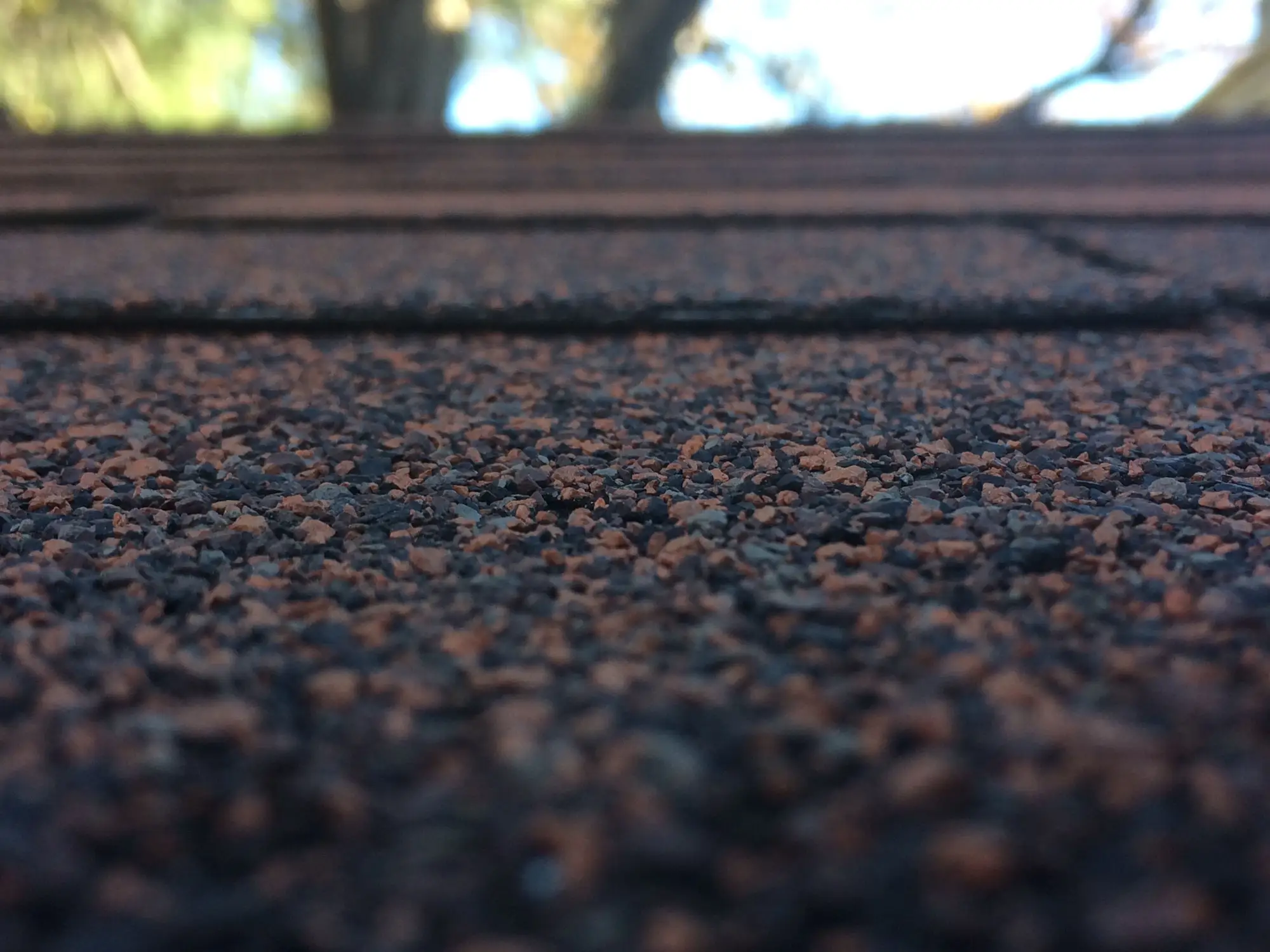
A patched roof and a repaired roof get coded the same way in most file notes, and that's the problem. One is a contractor who matched the course, feathered the tie-in, and left a roof that'll go the distance. The other is a landlord with a tarp and a mismatched bundle of shingles who called it "repaired" on the renewal questionnaire. From the ground, or from a windshield survey, you can't always tell them apart. From above, the difference usually shows.
What a patch looks like from above
Full reroofs read as uniform surfaces: one shingle lot, one granule wear pattern, laid in a single pass. Patches break that uniformity in a few specific, repeatable ways.
- Color and texture mismatch. A patch rarely matches the surrounding course exactly, even when the contractor tried. Sun-faded field shingles sit next to a darker, higher-granule patch, or the reverse if the patch is the older material and the field around it got redone later.
- Geometric boundaries that don't follow the roofline. Age and weather wear follows slope and exposure, in broad, soft gradients. A patch follows the shape of the damage underneath it: a square over a leak, a rectangle over a vent flashing, a ragged outline where a limb came down. That hard geometric edge is the tell.
- Tarp edges and fastener shadows. Tarps show up as flat, uniformly colored rectangles with crisp edges and, often, a small grid of shadow points where sandbags or furring strips hold the material down. A tarp visible at the time of the imagery capture tells you the repair is still open.
- Granule loss halos at the tie-in. Where a patch meets older shingle, you'll often see a narrow band of accelerated granule loss or staining on the old material, runoff concentrating right at the seam. That halo can matter more than the patch itself: it means the surrounding field is already shedding protection, patch or no patch.
None of this requires walking the roof. At VHR resolution (0.3 m or better) these color breaks, patch outlines, and tarp shadows are legible from a single annual capture, the same pass that's already picking up staining and granule loss on the rest of the roof.
Shingle patch vs full repair: why the distinction matters for the file
A full repair closes a claim and resets the clock on that section of roof. A patch, especially a tarp, is a flag that the underlying damage is still open and the scope was limited to stopping active leaking rather than addressing the roof as a whole. Coded identically in a loss run, those two outcomes carry very different renewal risk, and only one of them belongs on a short list for a closer look.
A renewal book holds thousands of addresses, and nobody on staff has time to open high-resolution imagery on every file every cycle just to check for a tarp. What a desk reviewer can actually use is a flag list: addresses showing patching, tarps, or a repair that doesn't match the surrounding field, pulled out of the rest of the book so the hand review starts there instead of at address one.
That's the gap Roof Scoring is built to close. It reads the same imagery a reviewer would pull manually, staining, granule loss, patching, tarps, across the whole book once a year, and hands back a per-address record sorted against your own underwriting guidelines instead of a folder of individual PDFs.
What the imagery won't tell you
A satellite pass won't tell you whether a patch was permitted, who did the work, or what the deck looks like underneath it. It tells you where the roof surface stops being uniform, and where that break sits relative to the rest of the field. For most renewal decisions, that's the part worth knowing before anyone drives out.
If your book has more roofs on it than your field team has days this cycle, start with a list that already tells you which addresses to visit first.