Lichen vs. algae staining on a roof: telling them apart overhead
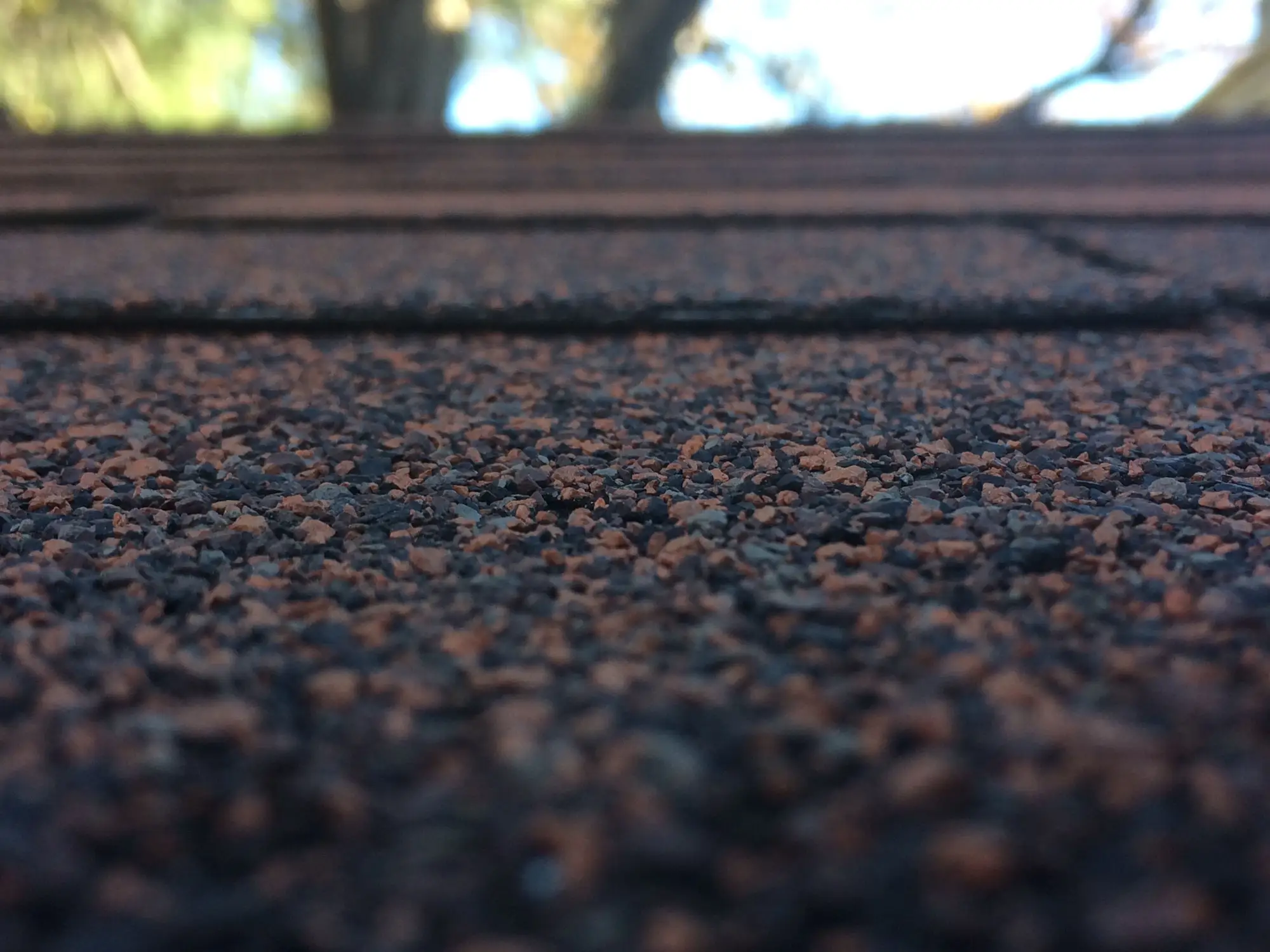
If you underwrite homeowner lines long enough, you start to recognize the dark marks on a roof from the thumbnail alone. Most adjusters and desk reviewers lump them together as "roof staining" and move on. But two of the most common stains, algae streaking and lichen colonies, mean different things for a file, and they don't look the same once you know what to check.
What you're actually looking at
Algae staining, usually caused by Gloeocapsa magma, shows up as dark streaks running down the slope of a shingle, typically starting near the ridge or around vent pipes and flashing where moisture collects longest. It's a surface organism feeding on the limestone filler in the shingle. Cosmetically it looks bad, sometimes bad enough to spook a homeowner into calling their agent, but it's not eating the shingle itself.
Lichen is a different organism entirely: a fungus and algae living together, and it behaves differently on the roof surface too. Instead of streaking with gravity, lichen grows in rounded, crusty patches that spread outward from a colonization point. It attaches to the granule surface and, over time, works granules loose as it grows and contracts with wet-dry cycles. That's the detail that matters for the file: lichen is associated with actual granule loss, not just discoloration sitting on top of a healthy shingle.
Telling them apart in overhead imagery
At the resolution we work with on Roof Scoring, 0.3 meter GSD or better, you're not resolving individual lichen bodies or algae cells. You're reading pattern, shape, and distribution, the same way you'd read a stain on a roof from a drone photo handed to you without context.
A few things hold up consistently:
Algae streaks follow water. They run down-slope in long, narrow bands, widest near the top of the run and often concentrated on the north-facing slope of the roof where shingles dry out slower. The color tends toward black or dark brown-black, and the edges of the streak are soft, not sharply bounded.
Lichen patches don't care about drainage. They show up as roughly circular or blotchy areas scattered across a slope, not confined to a flow path, and they don't thin out downhill the way algae does. Color leans gray-green to pale green rather than black, and the patch edges are more defined because the colony has a hard boundary where it's actively growing.
If you're staring at a roof with dark streaks that fan out from the ridge vents and run toward the eaves, that's almost always algae. If you're seeing scattered, uneven blotches with no relationship to slope or drainage, especially on a north or shaded exposure, that's more consistent with lichen, and it's worth a closer look at the rest of the slope for granule loss or patching nearby.
Why the distinction matters on a renewal file
Algae staining on its own is a maintenance and curb-appeal issue. Treating every dark-streaked roof as a red flag burns reviewer time on files that don't need a second look.
Lichen is different. Because it's tied to granule loss over time, a roof showing established lichen colonies alongside visible granule loss, patching, or an exposed mat in the same frame is telling you something about the roof's remaining service life, not just its appearance. That's a file worth routing for closer review or a reinspection trigger, where a purely cosmetic algae streak usually isn't.
Neither call is definitive from a single overhead frame. What an annual pass gives you is a consistent, repeatable read you can sort against your own guidelines, not a diagnosis. Staining type, pattern, and what else is visible on the same slope, that combination is what separates a cosmetic flag from a condition flag.
That's the read Roof Scoring is built to give you once a year across a renewal book: staining, granule loss, patching, and tarps scored per address, without sending anyone onto a roof to find out. If your book has more unknowns than you'd like going into renewal season, it's worth seeing what that annual pass turns up.